
Como instalar crown molding: 5 Flawless Steps
Why Crown Molding is the Perfect Upgrade for Your Home
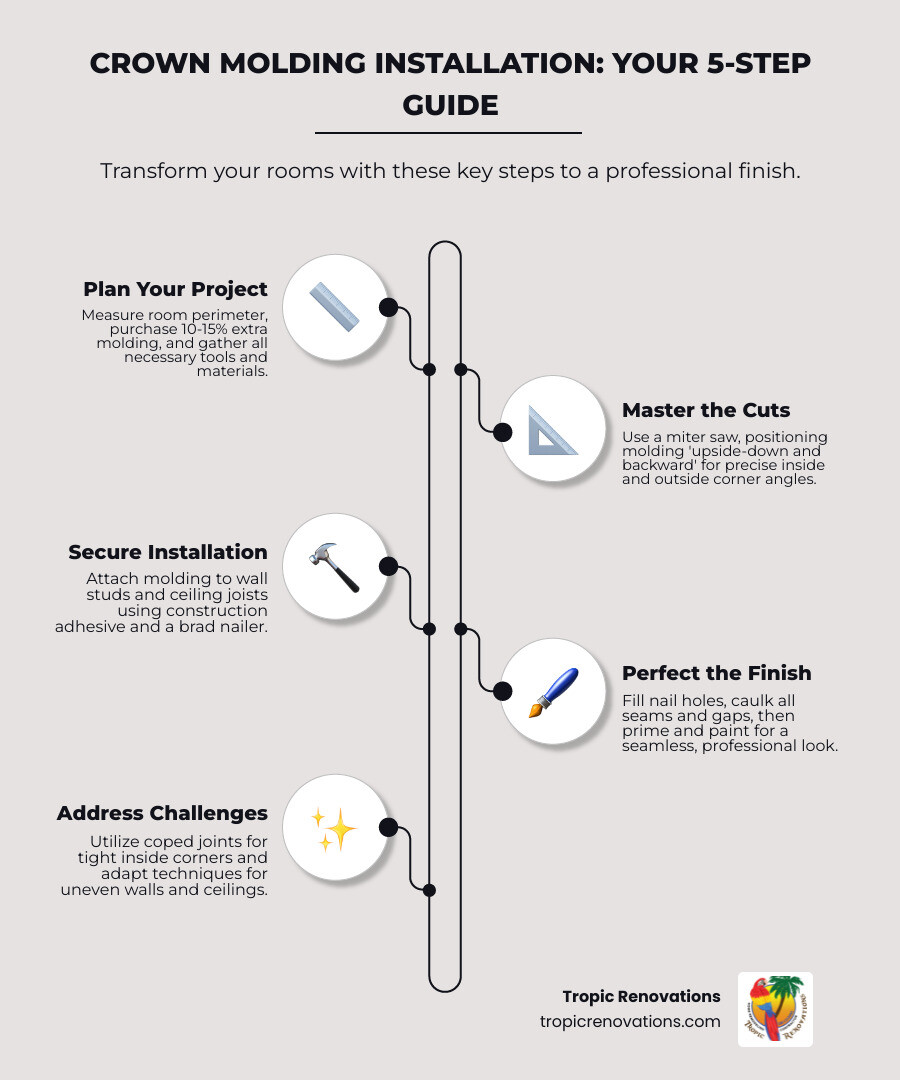
Como instalar crown molding is one of the most rewarding home improvement projects you can tackle to add instant character and value to any room. Here’s the quick overview:
- Plan your installation – Measure room perimeter, purchase 10-15% extra molding, and gather tools
- Cut precise angles – Position molding “upside-down and backward” on your miter saw for inside and outside corners
- Install securely – Attach to wall studs and ceiling joists using construction adhesive and brad nails
- Finish professionally – Fill nail holes, caulk all gaps, and paint for a seamless look
- Handle special situations – Use coped joints for inside corners and adjust for uneven walls
Crown molding bridges the corner where your walls meet the ceiling, creating depth and architectural interest that transforms builder-basic rooms into designer spaces. It’s a budget-friendly upgrade that typically costs between $50-$100 for materials when you DIY, and it can be completed in just a few hours once you understand the techniques.
This is considered an intermediate difficulty project, meaning you’ll need some basic carpentry skills and the right tools – especially a miter saw for making precise angled cuts. The trickiest part? Getting those corner joints to fit perfectly. But with the right approach, even beginners can achieve professional-looking results.
I’m Jeff Lexvold, and over my 20 years in construction and home renovation, I’ve personally worked on over 1,000 homes where como instalar crown molding was often the finishing touch that liftd the entire space. Through Tropic Renovations, my team and I have perfected dust-free installation techniques that deliver flawless results every time.
Step 1: Planning, Tools, and Materials
Before we dive into the nitty-gritty of cutting and installing, a little planning goes a long way. Think of this as laying the groundwork for a successful, headache-free project. We want to ensure we have everything we need, from the right amount of molding to the essential tools that will make the job easier.
When planning your layout, we always recommend starting your installation on the wall opposite the room’s main entrance. This ensures that the first view of your beautiful new crown molding is as seamless and impressive as possible. Consider how the molding will flow around the room, especially if you plan to incorporate decorative build-ups or accents. For rooms with higher ceilings or larger dimensions, you might even consider adding a decorative trim below the crown molding and painting the crown, trim, and the wall space in between the same color and finish. This technique “beefs up” the appearance, making the molding look more substantial and custom-fitted to your space.
Next, it’s time to measure the room’s perimeter. Grab your tape measure and carefully record the length of each wall where you’ll be installing molding. Once you have your total linear footage, don’t forget the golden rule of home improvement projects: buy extra! We advise purchasing at least 10-15% more molding than your calculated needs. This buffer accounts for any miscuts, mistakes, or unexpected damage, saving you from frustrating trips back to the store. For long walls, try to buy molding pieces that can run the full length, as this minimizes the number of joints you’ll need to create.
Choosing the right crown molding profile and material is also crucial. The profile you select will significantly impact the room’s aesthetic, from classic Colonial to sleek modern styles. As for materials, you have a few excellent options, each with its own advantages:

| Material | Pros | Cons |
|---|---|---|
| Wood | Shows detail beautifully, can be stained or painted, very durable | Can be harder to find in lengths over 12 feet, more expensive, can warp or shrink with humidity changes |
| MDF | Affordable, available in long lengths, takes paint well | Less durable than wood, can swell if exposed to moisture, not suitable for staining |
| Polyurethane | Durable, moisture-resistant, flexible, good for curved walls | Can be more expensive than MDF, less impact-resistant than wood, requires specific adhesives for installation |
For more inspiration and examples of how different profiles can transform a space, explore More info about our molding projects.
Essential Tools and Materials
Having the right tools and materials at hand makes all the difference between a frustrating struggle and a smooth, enjoyable installation. Here’s what you’ll need:
Tools:
- Miter saw: Your best friend for precise angle cuts.
- Tape measure: For accurate measurements.
- Stud finder: To locate studs and ceiling joists for secure nailing.
- Level: For marking layout lines.
- Brad nailer: An 18-gauge or 16-gauge finish nailer will make quick work of securing the molding.
- Coping saw: Essential for creating tight inside corner joints.
- Caulk gun: For applying caulk and adhesive.
- Wood rasp: For fine-tuning coped joints.
- Sandpaper: 100-grit and 180-grit for preparing and smoothing surfaces.
- Finishing tool: A small plastic tool or even your finger for smoothing caulk beads.
- Safety glasses and hearing protection: Always protect your eyes and ears when working with power tools!
- Carpenter’s pencil, painter’s tape, carpenter’s square, tack cloth: For marking, holding pieces, ensuring squareness, and cleaning.
Materials:
- Crown molding: The star of the show!
- 1.5-inch brad nails: For securing the molding.
- Construction adhesive: A heavy-duty adhesive with instant grab helps hold molding in place while you nail, and provides extra security. Look for “no run, no drip” varieties to avoid messy squeeze-out.
- Wood filler: For filling nail holes.
- Paintable caulk: A flexible, paintable sealant for filling gaps and seams.
- Primer and paint: To finish your molding beautifully.
Step 2: Como Instalar Crown Molding – The Art of the Cut
This is where many DIYers get intimidated, but with the right technique, cutting crown molding accurately is entirely achievable. The key to successful crown molding installation lies in mastering your miter saw and understanding how the molding sits.
The most critical concept for cutting crown molding on a miter saw is the “upside-down and backward” rule. Imagine the molding in its final position on the wall. Now, flip it upside down and rest the “ceiling edge” of the molding flat on the miter saw’s base, while the “wall edge” rests against the saw’s fence. This simulates the molding’s installed angle, allowing you to make precise miter and bevel cuts. Crown molding typically has a “spring angle” – the angle at which it sits against the wall and ceiling, common angles being 38, 45, and 52 degrees. For a standard 45-degree crown molding, you’ll often set your saw’s bevel at 30 degrees and the miter at 35.3 degrees, but these settings can vary depending on your specific molding. If you’re tackling non-standard corners, an online crown molding angle calculator can be an invaluable resource.
Understanding the different types of corner joints is also essential. We primarily use two types: mitered and coped.
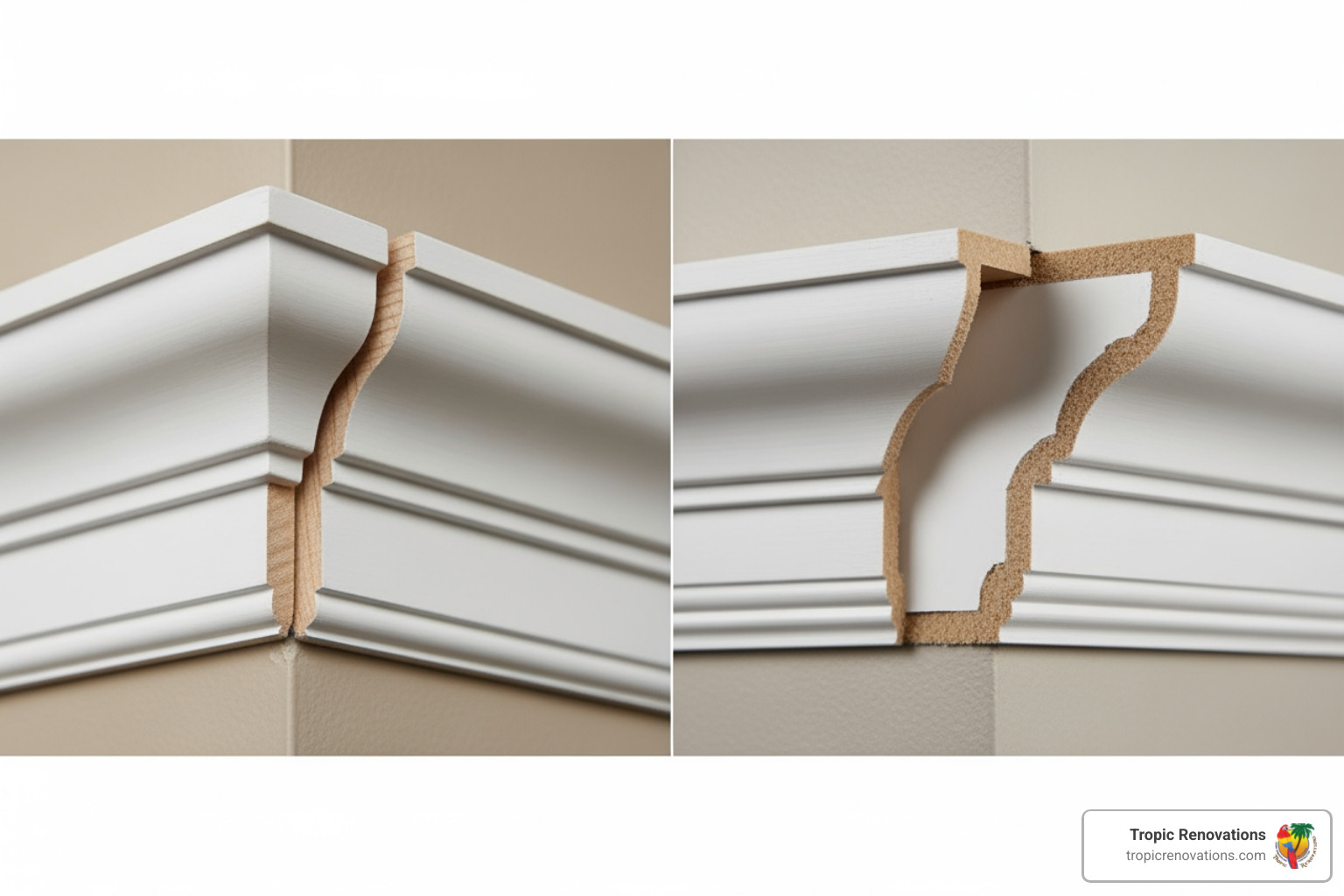
- Mitered joints: These are simple 45-degree angle cuts that meet to form a 90-degree corner. They are generally used for outside corners.
- Coped joints: These are more complex, where one piece of molding is cut to precisely fit the profile of the adjacent piece. They are ideal for inside corners, especially when walls aren’t perfectly square.
For long walls, you’ll inevitably need to join two pieces of molding. This is where a scarf joint comes in handy. To create a scarf joint, you’ll cut both meeting ends of the molding at a 45-degree angle, but in opposite directions. For example, one piece will have its finished side cut “up,” and the other will have its finished side cut “down.” This creates an overlapping, puzzle-like fit that’s visually seamless. Always make sure these joints fall over a wall stud for maximum stability.
How to Make Precise Inside Corner Cuts
For inside corners, we strongly advocate for the coped joint technique. While it might seem more challenging initially, a coped joint offers a much tighter, more forgiving fit, especially in older homes where walls are rarely perfectly square.
Here’s how we approach it:
- First Cut: Position your molding “upside-down and backward” on your miter saw. Make a 45-degree inside miter cut on the end of the molding. This cut will expose the profile you need to cope.
- Coping with a Saw: Clamp the molding securely. Using a coping saw (ensure the teeth point towards the handle for smooth cutting on the pull stroke), carefully cut along the front edge of the miter, following the molding’s profile. As you cut, tilt the coping saw blade back a few degrees to create a slight back-bevel. This back-bevel ensures that only the very front edge of the joint touches, allowing for a tight fit even if the corner isn’t perfectly 90 degrees. If your coping saw blade tends to slide, a small starter notch with a utility knife can help.
- Fine-Tuning: After making the cut, use a wood rasp or sandpaper to fine-tune the coped edge, removing any small imperfections. We’re aiming for a razor-thin edge where the moldings meet.
- Test Fit: Always test-fit your coped piece with a scrap piece of molding that has a square cut. You can cut the final piece of molding about 1/8-inch longer than the wall measurement. This extra length helps push the cope joint closed, ensuring a snug fit.
Practice makes perfect. Don’t be afraid to make a few test cuts on scrap pieces until you feel confident.
How to Make Precise Outside Corner Cuts
Outside corners are typically handled with mitered joints, which are simpler than coped joints but still require precision.
- Positioning: Again, place your molding “upside-down and backward” on your miter saw.
- Making the Cut: For an outside corner, you’ll be cutting a 45-degree angle. One piece will have a short bottom edge and a long top edge, and the other piece will mirror it.
- Slightly Longer: We recommend cutting each piece about 1/16-inch to 1/8-inch longer than your marked measurement. This slight excess allows you to sneak up on the perfect fit.
- Test and Adjust: Test fit the two pieces on your corner. If the joint isn’t perfectly tight, make small adjustments to your miter saw’s angle (e.g., shifting from 45 degrees to 46 degrees) until you achieve a seamless fit. It’s much easier to take off a tiny bit more than to add it back!
Step 3: Installation and Finishing Touches
With your carefully cut pieces ready, it’s time to bring your vision to life by attaching the molding. This step requires a steady hand and attention to detail to ensure a beautiful, lasting finish.
First, we need to know where to secure our molding. Use your stud finder to locate and mark the wall studs and ceiling joists. These are the strong points where your nails will anchor the molding most effectively. For accuracy, you can create an L-shaped gauge from scrap wood to mark a consistent placement line on both your walls and ceiling where the top and bottom of the molding will sit.
Before nailing, we always apply a bead of construction adhesive to the back of the molding, particularly where it will contact the wall and ceiling. A high-quality, heavy-duty construction adhesive with a strong instant grab will help hold the molding in place, making nailing easier and providing an extra layer of security. Look for glues that are “no run, no drip” to prevent messy squeeze-out. If any adhesive does squeeze out, wipe it away immediately with a damp cloth.
Now, it’s time to nail. Use your brad nailer with 1.5-inch brad nails, driving them into the marked studs and joists. We typically place nails about every foot or so. If you can’t hit a joist in the ceiling, drive nails in at a 45-degree angle for better holding power. For long stretches, especially, having a helper to hold the molding steady while you nail can be invaluable. This is definitely a project where two sets of hands make lighter work!
Common mistakes to avoid:
- Cutting angles backward: Always re-verify your “upside-down and backward” saw setup. A quick dry-fit check before the final cut can save you a board.
- Not buying enough material: Running out mid-project is frustrating and can delay completion. That 10-15% extra material is a lifesaver!
- Skipping dry-fits: Always test your cuts before permanent installation. It’s easier to adjust a dry piece than a glued and nailed one.
- Ignoring studs/joists: Nailing only into drywall won’t provide a secure, long-lasting installation.
Once all your molding is securely in place, it’s time for the finishing touches that truly lift the look from DIY to professional.
- Fill Nail Holes: Use a quality wood filler (some even change color when dry, like DAP® PLASTIC WOOD® All Purpose Wood Filler with DryDex technology). Apply a small amount, slightly overfilling the hole. Once dry, sand it flush with 100-grit sandpaper for a smooth surface.
- Caulk Gaps and Seams: Even with the most precise cuts, small gaps can appear where the molding meets the wall and ceiling, or at joints. This is where paintable caulk shines. Apply a thin, even bead of DAP® ALEX FLEX® Premium Molding & Trim Sealant along all seams and joints. Use a finishing tool or a damp finger to smooth the caulk for a clean, professional line. This sealant is often ready for paint in as little as 30 minutes.
Best Practices for Painting and Finishing
For a truly impeccable finish, we follow a specific painting process.
- Prime First: If your molding isn’t pre-primed, we highly recommend priming it before installation. A quality primer like ZINSSER® Bulls Eye 1-2-3® Primer is excellent. It dries quickly (often in an hour) and helps prevent the molding from warping. For bare wood molding, we suggest sanding with 100-grit sandpaper, wiping it clean with a tack cloth, applying primer, lightly sanding with 180-grit sandpaper, and then applying your first coat of paint. This prep work saves significant time and effort after installation.
- Final Coat: After all your wood filler has dried and been sanded smooth, and your caulk has fully cured, it’s time for the final coat of paint. This step ties everything together, creating a seamless, polished look that will make your crown molding appear as if it was always meant to be there.
Step 4: Advanced Tips and Troubleshooting
Even with careful planning and execution, you might encounter a few hiccups along the way. Don’t worry, these are common and usually easy to fix!
Troubleshooting common problems:
- Gaps in corners: If you find small gaps in your mitered or coped corners, don’t panic. For minor gaps, a good quality paintable caulk can work wonders. For larger gaps, you might need to carefully recut the piece or use wood filler if it’s a mitered joint. Sometimes, adjusting the angle of your saw by a fraction of a degree can make all the difference.
- Uneven ceilings or walls: This is a reality in many homes, especially older ones in Sarasota and Charlotte County. Coping inside corners is your best defense against uneven walls. For ceilings that aren’t perfectly flat, flexible, paintable caulk can hide minor imperfections. For more significant discrepancies, you might consider “scribing” the top edge of the molding to match the ceiling’s contour, although this is an advanced technique. Strategic nailing can also help pull the molding tightly into place, conforming to slight irregularities. Remember the “10-foot rule”: if you can’t see a minor imperfection from 10 feet away, it’s probably not worth losing sleep over!
- Molding not sitting flat: Check for any obstructions behind the molding, like old paint drips or drywall bumps. A quick scrape or sand can fix this. Shims can be used discreetly behind the molding to fill small voids, and secure nailing will help pull it flush. Consider using toggle bolts if you can’t find ceiling joists, positioning them every 16 inches for solid anchorage.
Advanced techniques for a professional finish:
- Layering molding: For a truly custom and luxurious look, consider creating a “built-up” crown molding. This involves installing multiple pieces of molding—perhaps a base molding on the ceiling, an upside-down base molding on the wall, and then the sprung crown molding nailed to the other two. This layered approach adds incredible depth and architectural interest.
- Using a cutting jig: While not strictly necessary, a crown molding cutting jig can simplify the “upside-down and backward” setup on your miter saw, providing a stable platform for consistent cuts.
Como instalar crown molding on cabinets
Installing crown molding on cabinets presents its own unique set of considerations compared to walls, but it’s a fantastic way to give your kitchen or other cabinetry a solid, finished, high-end look. This is a project that can often be completed in just a few hours.
- Smaller profiles: Cabinet crown molding is typically smaller in width, often ranging from 1-5/8 to 3-5/8 inches, whereas wall-to-ceiling crown can be much wider. This smaller scale requires even greater precision in cuts.
- Partial vs. Full Overlay Doors:
- Partial Overlay: If your cabinet doors leave an exposed face frame (often 1 to 1-1/4 inches), you can typically attach the crown molding directly to this face frame.
- Full Overlay: For cabinets with full overlay doors that cover the entire face frame, you’ll need to add nailing cleats around the top perimeter of the cabinet. These cleats provide a solid surface to which you can attach the crown molding. We often extend these cleats about one inch past the cabinet top for a flush look with the full overlay doors. Gussets, cut at an angle matching the crown’s spring angle, can also be added for extra strength and stability.
- Pre-assembling sections: Especially for full overlay cabinets where nailing cleats are involved, we find it incredibly efficient to pre-assemble sections of the crown molding and cleats. You can build small “boxes” of molding for each cabinet run, securing the molding to the cleats and even gluing miter joints before attaching the entire assembly to the cabinet. This can be a huge time-saver and often results in more precise joints.
- “Helping Hand” Technique: When working alone on cabinets, a trick we often use is masking tape as a “helping hand.” It can temporarily hold a piece of molding in place while you measure or prepare for nailing.
- Transfer Measurement: For very precise miter cuts on cabinets, use the “transfer measurement” technique. Instead of a tape measure, transfer the measurement directly from the cabinet corner to your molding piece. This minimizes errors and ensures perfect-fitting miters.
Como instalar crown molding on uneven ceilings
Dealing with uneven ceilings is a common challenge, especially in older homes in our Southwest Florida communities. Here’s how we approach it:
- Scribing the top edge: For significant unevenness, an advanced technique called scribing can be used. This involves holding the molding in place, marking the ceiling’s contour onto the top edge of the molding, and then carefully cutting or sanding the molding to match. This allows the molding to sit perfectly flush against the irregular ceiling line.
- Flexible, paintable caulk: For minor variations, a high-quality, flexible, paintable caulk is your best friend. After installation, fill any gaps between the molding and the ceiling. The flexibility of the caulk allows it to accommodate slight movements and hide imperfections beautifully.
- Strategic nailing: When dealing with slight bows or dips, you can use your brad nailer strategically. Apply firm pressure to the molding to push it into place, then nail it securely. This can help pull the molding into alignment with the ceiling. If ceiling joists are hard to find or run parallel to the molding, toggle bolts can provide secure anchorage at regular intervals.
Frequently Asked Questions about Crown Molding Installation
Should I use coped or mitered joints for inside corners?
For inside corners, we wholeheartedly recommend coped joints. While they require a bit more effort to master, they are far superior. Coped joints create a tighter, more forgiving fit, especially crucial in homes where walls are rarely perfectly square. Mitered joints for inside corners tend to open up over time due to seasonal expansion and contraction, creating unsightly gaps. Mitered joints, however, are the preferred choice for outside corners.
What is the most common mistake when installing crown molding?
Hands down, the most common mistake is cutting the angles backward. This usually happens when installers forget the “upside-down and backward” rule for positioning the molding on the miter saw. Always take a moment to visualize how the molding will sit on the wall and ceiling, and then orient it correctly on your saw to simulate that position. Making a few practice cuts on scrap pieces can prevent this costly error.
Can I install crown molding by myself?
While it’s certainly possible for a determined DIYer to install crown molding solo, we find that it’s a project made significantly easier and more enjoyable with a helper. An extra set of hands is invaluable for holding long, flexible pieces of molding steady while you measure, position, and nail. This is especially true for longer walls or when dealing with slightly awkward angles. If you’re tackling it alone, painter’s tape or temporary supports can act as your “helping hand.”
Conclusion: Lift Your Home with Flawless Crown Molding
We hope this extensive guide has demystified the process of como instalar crown molding and empowered you to tackle this transformative home improvement project with confidence. Adding crown molding is more than just a decorative touch; it’s an investment that significantly improves your home’s aesthetic appeal, adds architectural elegance, and ultimately contributes to its overall value. It’s a challenging, but incredibly rewarding DIY endeavor that instantly lifts any room from ordinary to extraordinary.
However, we understand that not everyone has the time, tools, or inclination to take on such a detailed project. If you’re looking for professional, dust-free renovation services, or if you encounter complex challenges like severely uneven walls or intricate designs, knowing when to call in the experts is key. Our experienced team at Tropic Renovations specializes in flawless installations, ensuring that your crown molding looks perfect every time, without the headaches of DIY. We’re proud to serve the communities across Charlotte County, Sarasota County, and Southwest Florida, including Casey Key, Englewood, Manasota Key, Nokomis, North Port, Osprey, Palmer Ranch, Siesta Key, and Venice.
Ready to lift your space? Learn more about our expert crown molding and trim services and let us help you achieve that perfect, finished look.