
How to check contractor? 5 Crucial Pillars
Why Knowing How to Check Contractor Credentials Protects Your Home and Wallet
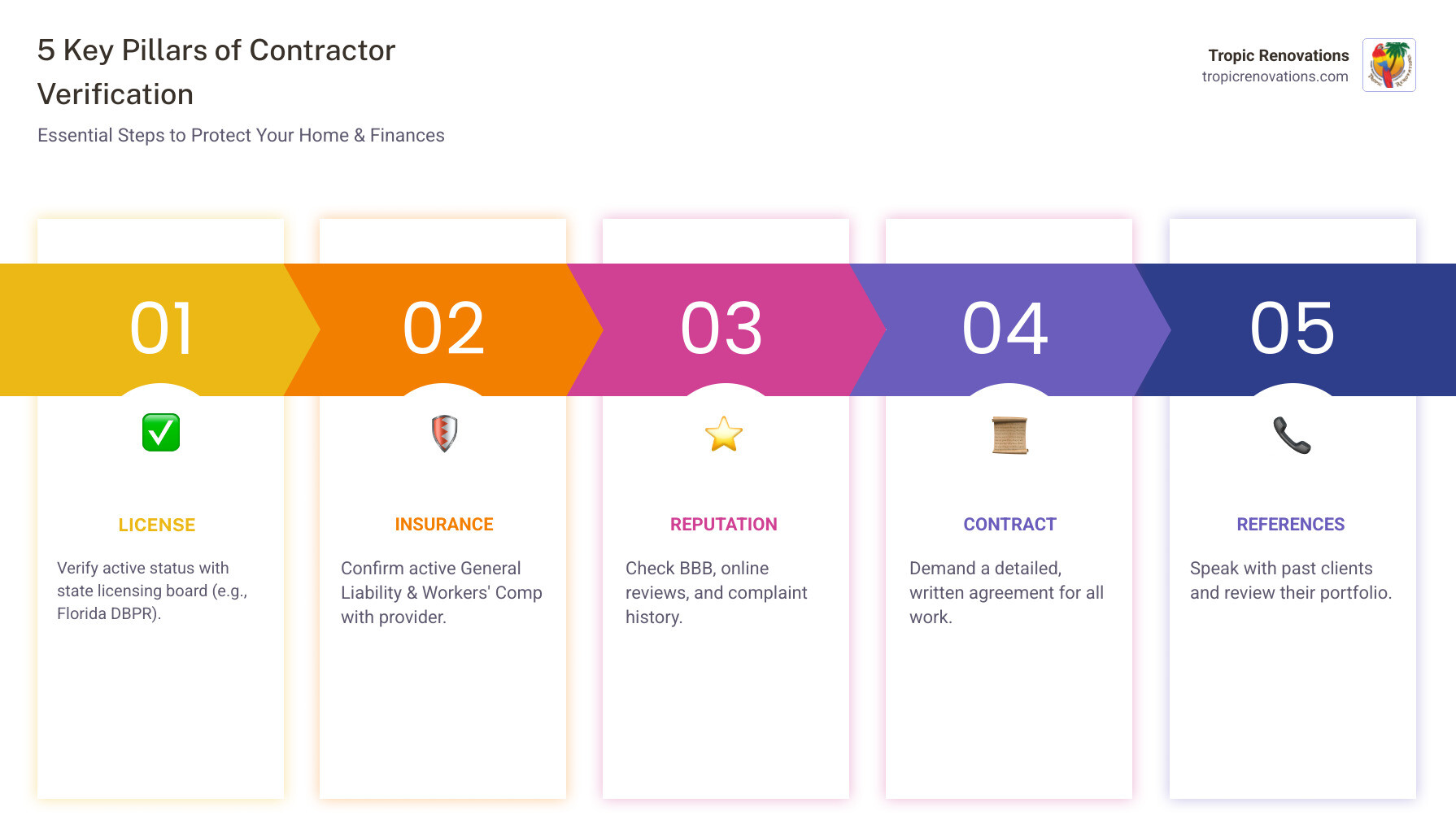
How to check contractor credentials before hiring is simple when you follow these essential steps:
- Verify their license status through your state’s licensing board website (Florida DBPR for local residents)
- Confirm active insurance coverage by requesting a Certificate of Insurance and calling the provider directly
- Check complaint history on the Better Business Bureau and state licensing board records
- Review their online reputation through Google reviews, Houzz, and other industry platforms
- Verify their business location with a physical address (not just a P.O. Box)
- Get everything in writing including detailed contracts with license and insurance information
- Confirm they pull proper permits for all work requiring them
There’s no way around it. Every house in Southwest Florida, no matter how new or well-maintained, will eventually need repairs or upgrades. But here’s the reality: hiring the wrong contractor can cost you thousands of dollars in shoddy repairs, legal liability, or worse—complete project abandonment.
The good news? You don’t need to be an expert to protect yourself. You just need to know what to look for and where to look.
According to California’s licensing board, homeowners should always hire contractors who have been in business for at least 5 to 10 years with active licenses. In Florida, contractors working on projects valued at $500 or more must hold valid state licenses. Yet every year, homeowners across the country lose hundreds or thousands of dollars to unlicensed operators and scammers—many of whom disappear after taking large deposits.
The risks aren’t just financial. If an uninsured worker gets injured on your property, you could be held personally liable for their medical bills and rehabilitation costs. Your homeowner’s insurance might not cover it either.
That’s why verifying contractor credentials isn’t optional—it’s essential due diligence that protects your home, your family, and your finances.
I’m Jeff Lexvold, and over nearly two decades in construction and home renovation, I’ve personally worked on and helped renovate over 1,000 homes before founding Tropic Renovations in Florida. Through those years, I’ve learned exactly how to check contractor credentials to separate the professionals from the pretenders—and I’m here to walk you through it step by step.
How to check contractor? terms to know:
- do i need a contractors license to remodel homes
- how to request a contractor home remodel quote
- can you remodel your home without a general contractor
The First Step: Verifying Licenses and Insurance
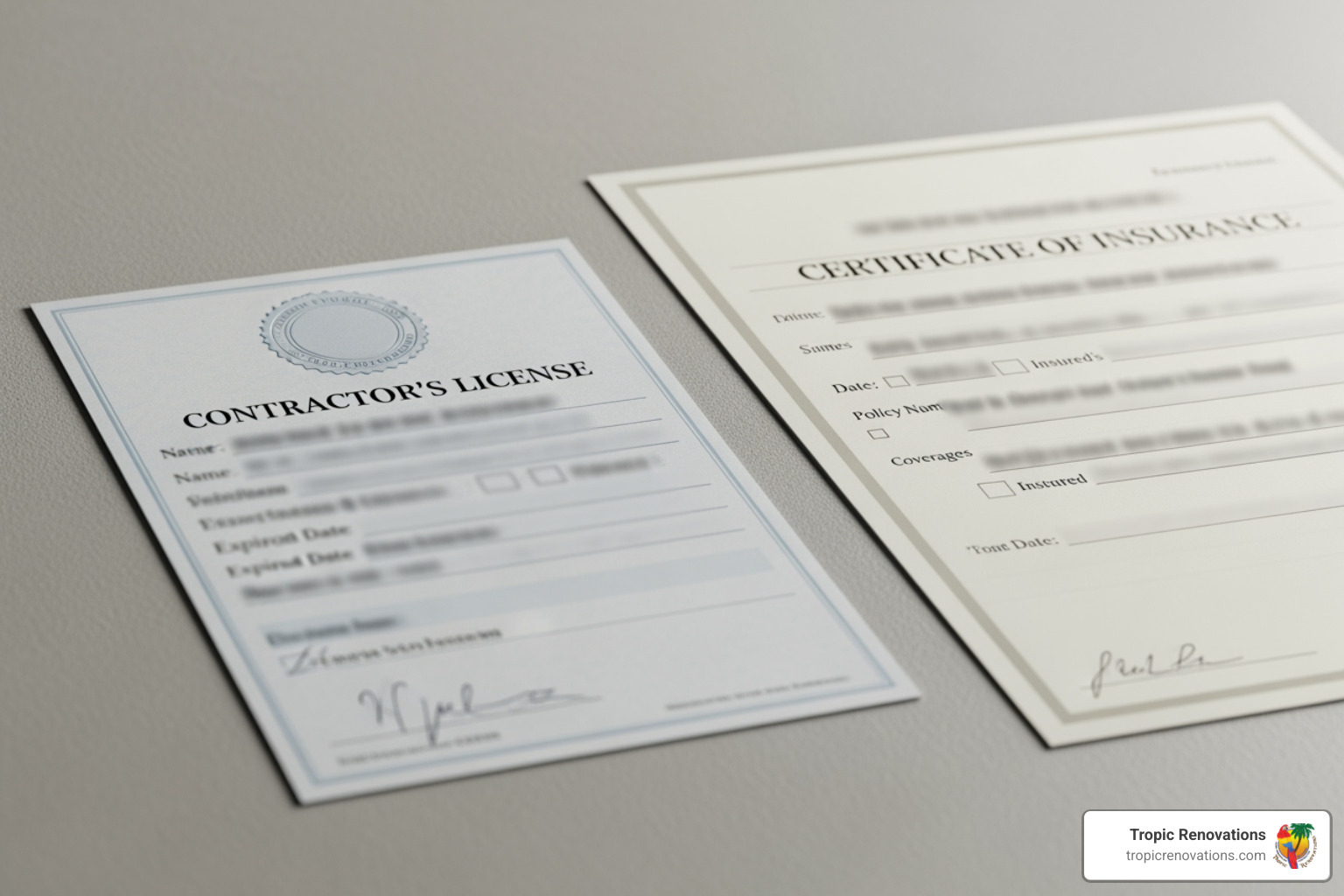
Let’s cut to the chase: when you’re thinking about how to check contractor credentials, license and insurance verification should be your first stop. These aren’t just nice-to-haves. They’re non-negotiables that form the foundation of any legitimate contractor relationship. Think of them as your financial and legal safety net—without them, you’re walking a tightrope with no protection.
Why Verifying a Contractor’s License and Insurance is Crucial
Here’s something that keeps me up at night: homeowners who skip this step. I’ve seen too many people learn the hard way why these credentials matter.
Let’s start with the obvious one—property damage. Imagine you’re having your kitchen remodeled, and a worker accidentally breaks a water line. Water floods your new hardwood floors in the adjacent room. If your contractor doesn’t have proper insurance, guess who’s paying for that damage? You are. Hiring an insured contractor protects you from any damage or accidents that may occur on the job. It’s that simple.
But it gets worse. Personal injury liability is even scarier. If a worker falls off a ladder on your property and the contractor doesn’t have workers’ compensation insurance, you could be financially liable to pay for injuries and rehabilitation. We’re talking medical bills, lost wages, ongoing therapy—potentially tens of thousands of dollars. Your homeowner’s insurance might not cover these scenarios either, leaving you completely exposed.
Here in Florida, just like in California, contractors must hold a valid license if they’re working on projects valued at $500 or more for combined labor and materials. This isn’t bureaucratic red tape—it’s proof they have the necessary knowledge and training to do the work safely and correctly. Without it, you’re risking shoddy work that could cost more to fix than the original project would have cost.
And let’s talk about avoiding scams. Unlicensed contractors are often the ones who disappear after taking large down payments, leaving you with unfinished projects and empty pockets. By verifying credentials, you gain recourse for shoddy work and protect yourself from fraudulent practices.
At Tropic Renovations, we’re a state-licensed home remodeling contractor in Sarasota & Charlotte County, FL. We always provide proof of our active licenses and comprehensive insurance coverage upfront. It’s part of our commitment to your peace of mind. Are You Insured?
How to check contractor’s license status online
The good news? Checking a contractor’s license is surprisingly easy. Start by simply asking for their license number. Reputable contractors will hand it over without hesitation—it’s often printed right on their business cards, websites, and bids.
Once you have that number, head to your state licensing board website. For our Florida clients, that’s the Florida Department of Business and Professional Regulation (DBPR) website. The process is similar in every state. While we’ve linked to California’s CSLB as an example, you can check your state’s online license portal using the same basic steps.
What will you find when you look up that license? First, check the license status. Is it active, inactive, expired, suspended, or revoked? We only want to work with contractors whose licenses are active and in good standing. Anything else is a red flag you can’t ignore.
Next, look at the license classification. This tells you what type of work the contractor is legally allowed to perform. A general contractor has a broader scope than a specialized roofing contractor, for example. Make sure their license covers the specific work you need done. You wouldn’t hire an electrician to do your plumbing, right?
Here’s where it gets really interesting: complaint history. Many state boards, including Florida’s DBPR and California’s CSLB, will show you public complaints, disciplinary actions, and sometimes even judgments or arbitrations against a contractor. This information is gold for gauging their reliability.
If a contractor can’t provide a license number, or if their license status comes back as anything other than “active” and “in good standing” for your type of work, walk away. Seriously. It’s simply not worth the risk.
Understanding and Verifying Contractor Insurance
Insurance is just as critical as licensing, but there are two different types you need to verify.
Commercial General Liability (CGL) Insurance protects you against claims of property damage and bodily injury arising from the contractor’s work. This is important even if it’s not legally required in some states. If that water line breaks or someone gets hurt because of the work being done, this coverage protects both you and the contractor.
Workers’ Compensation (WC) Insurance is required by law in most states if a contractor has employees. This protects contractors—and you—from liability for injuries to their workers while on the job. Without this coverage, an injured worker could potentially sue you as the property owner.
| Insurance Type | What it Covers |
|---|---|
| Commercial General Liability (CGL) Insurance | Protects against claims of property damage and bodily injury arising from the contractor’s work. Covers damage to your property and injuries to third parties. |
| Workers’ Compensation (WC) Insurance | Protects contractors from liability for injuries to their employees while working on a project. Required by law in most states if a contractor has employees. |
Here’s how you actually verify this coverage: Ask for a Certificate of Insurance (COI). This document should list both types of insurance, the policy limits, and the coverage dates. But don’t stop there—call the insurance provider directly to confirm the policy is active and covers the dates of your project.
Pay attention to the policy limits too. They should be substantial enough to cover potential damages for a project of your scale. A million-dollar policy is a common standard for general liability. And here’s a critical detail many homeowners miss: if your contractor uses subcontractors, you must verify that each one carries their own insurance. Don’t just take the general contractor’s word for it, as their policy may not extend to independent subs. This creates a complicated web of liability and paperwork for you. At Tropic Renovations, we simplify this process entirely because we never subcontract our core trades. The skilled technicians working on your kitchen or bath are our direct employees, covered under our comprehensive insurance policies. This gives you a single point of accountability and peace of mind, knowing everyone on your property is properly insured.
Bottom line? Verifying insurance takes 15 minutes and could save you from financial devastation. Every single time, it’s worth the effort.