
Dust free remodeling? 3-Pronged Clean Secrets
Why Construction Dust is Your Renovation’s Biggest Enemy
Dust free remodeling? isn’t just a luxury – it’s essential for protecting your health and home during any renovation project. The answer is yes, truly dust-free remodeling is possible with the right containment systems, specialized tools, and professional techniques.
Quick Answer: Dust-Free Remodeling Methods
- Containment: Plastic barriers, sealed doorways, negative air pressure
- Collection: HEPA vacuums, dust extractors on tools, air scrubbers
- Cleaning: Daily maintenance, wet wiping, post-project deep clean
- Professional Tools: Vacuum-assisted sanders, wet-cutting techniques
- Health Protection: Prevents silica exposure, reduces respiratory risks
Home renovations are exciting. You’re finally getting that dream kitchen or bathroom you’ve always wanted. But there’s a dark side to remodeling that many homeowners don’t expect: the dust nightmare.
Construction dust isn’t just annoying – it’s dangerous. According to research, airborne dust can cause serious health problems and damage HVAC systems. Even worse, dust can settle into every corner of your home and linger for five to six weeks after renovation is complete.
The good news? You don’t have to choose between your dream renovation and a livable home. With proper dust control strategies, you can have both.
The stakes are higher than you think. OSHA classifies silica dust as a health hazard capable of causing lung disease. Tools with built-in dust mitigation systems can remove as much as 90 percent of dust when it’s generated. That’s the difference between breathing clean air and inhaling harmful particles every day.
Know your Dust free remodeling? terms:
- Cost of bathroom remodel?
- how to budget for your home remodel with a contractor
- how to find a reliable home remodel contractor
Why Dust Control is Non-Negotiable in Home Remodeling
Picture this: you’re excited about your dream kitchen renovation, but three days into the project, your entire house looks like a construction zone. Dust coats everything from your grandmother’s china to your laptop keyboard. Your family starts coughing, and you realize this “little bit of dust” has become a serious problem.
This scenario plays out in countless homes because many people don’t understand the real dangers of construction dust. Dust free remodeling? isn’t just about keeping things tidy – it’s about protecting your family’s health and your home’s value.
The truth is, construction dust poses significant risks that go far beyond the inconvenience of extra cleaning. That’s why proper dust control isn’t optional for us at Tropic Renovations. It’s the foundation of every project we tackle.
The Hidden Dangers of Construction Dust
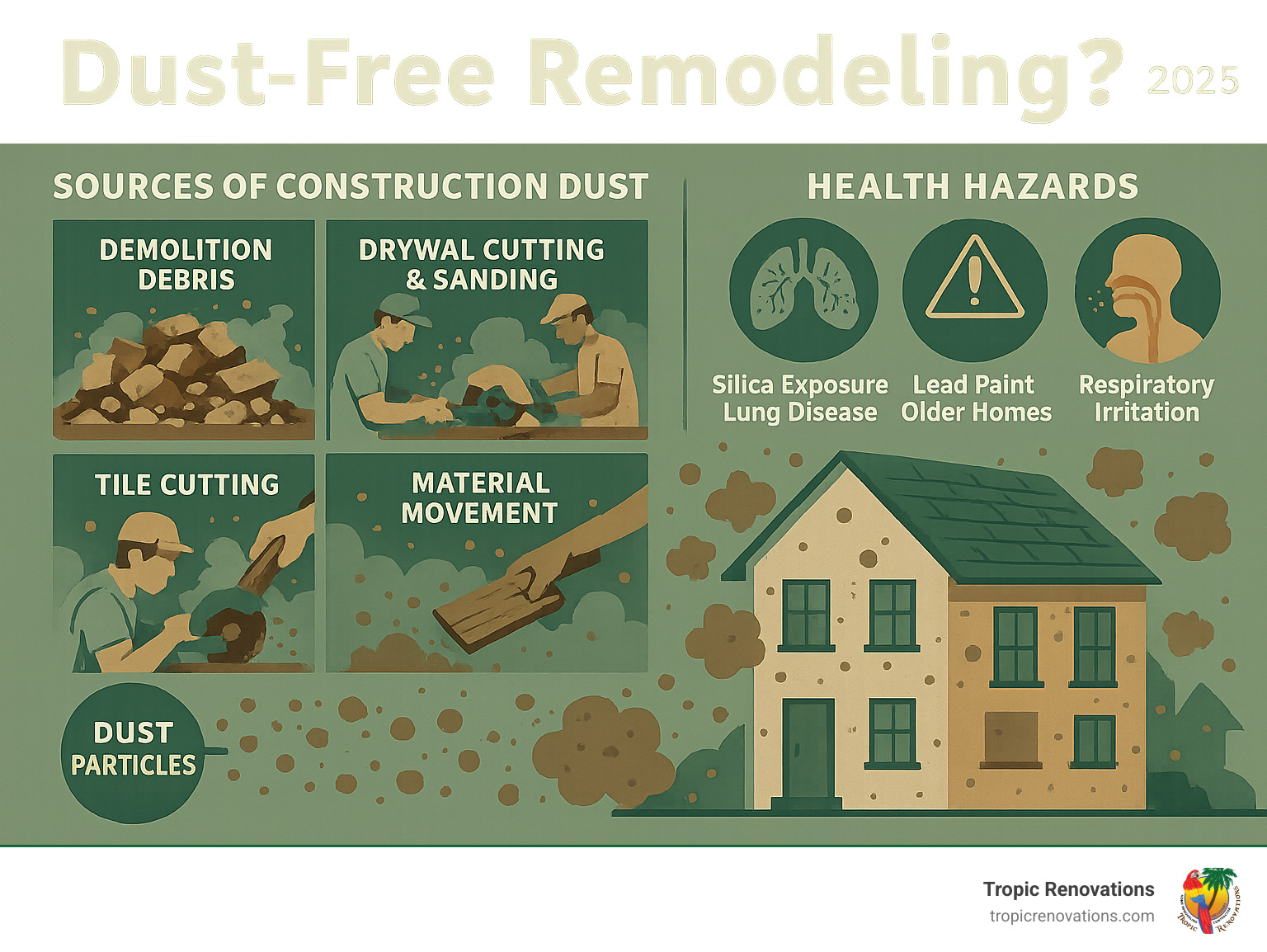
Construction dust isn’t just “dirt” – it’s a dangerous mix of microscopic particles that can seriously harm your health. Think of it as an invisible enemy that’s much more threatening than it appears.
Silica dust is one of the worst offenders. This nasty stuff gets released whenever we cut, grind, or sand materials like concrete, tile, brick, stone, and even drywall. OSHA doesn’t mess around when it comes to silica – they classify it as a serious health hazard that can cause lung diseases, including silicosis and lung cancer.
Here’s what makes silica dust so dangerous: these particles are incredibly tiny, less than 1/30th the size of a human hair. They slip right past your body’s natural defenses and lodge deep in your lungs, where they can cause lasting damage. Even short-term exposure can severely irritate your respiratory system, especially if you have children, elderly family members, or anyone with breathing problems in your home.
But silica is just the beginning. In older homes, we often encounter dust containing lead paint particles, which are highly toxic, particularly to children and pregnant women. There’s also the risk of asbestos fibers in homes built before the late 1970s, and mold spores that become airborne during demolition.
Scientific research on harmful chemicals in house dust shows that dust can harbor harmful bacteria, viruses, and chemical compounds that have been linked to various health concerns. For homeowners dealing with existing moisture issues, cracks can lead to mold, making dust control even more critical.
The real problem with these fine particles is how long they stick around. They can float in your air for hours, get sucked into your HVAC system, and then slowly settle on every surface in your home. Even after we finish your renovation, you might find dust on your belongings for weeks. That’s not just annoying – it means your family keeps breathing these harmful particles long after the work is done.
Protecting Your Property and Valuables
Beyond the health risks, uncontrolled construction dust can wreak havoc on your property. Imagine fine grit settling into your electronics and damaging sensitive components, or dust embedding itself so deeply into your flooring that you need expensive professional cleaning or even replacement.
Your HVAC system is particularly vulnerable during renovations. When dust gets into your air ducts, it doesn’t just stay there – it circulates throughout your entire home, spreading contaminants and potentially damaging your furnace and air conditioning units. This is why we always seal all vents and often turn off your HVAC system during heavy dust-generating activities.
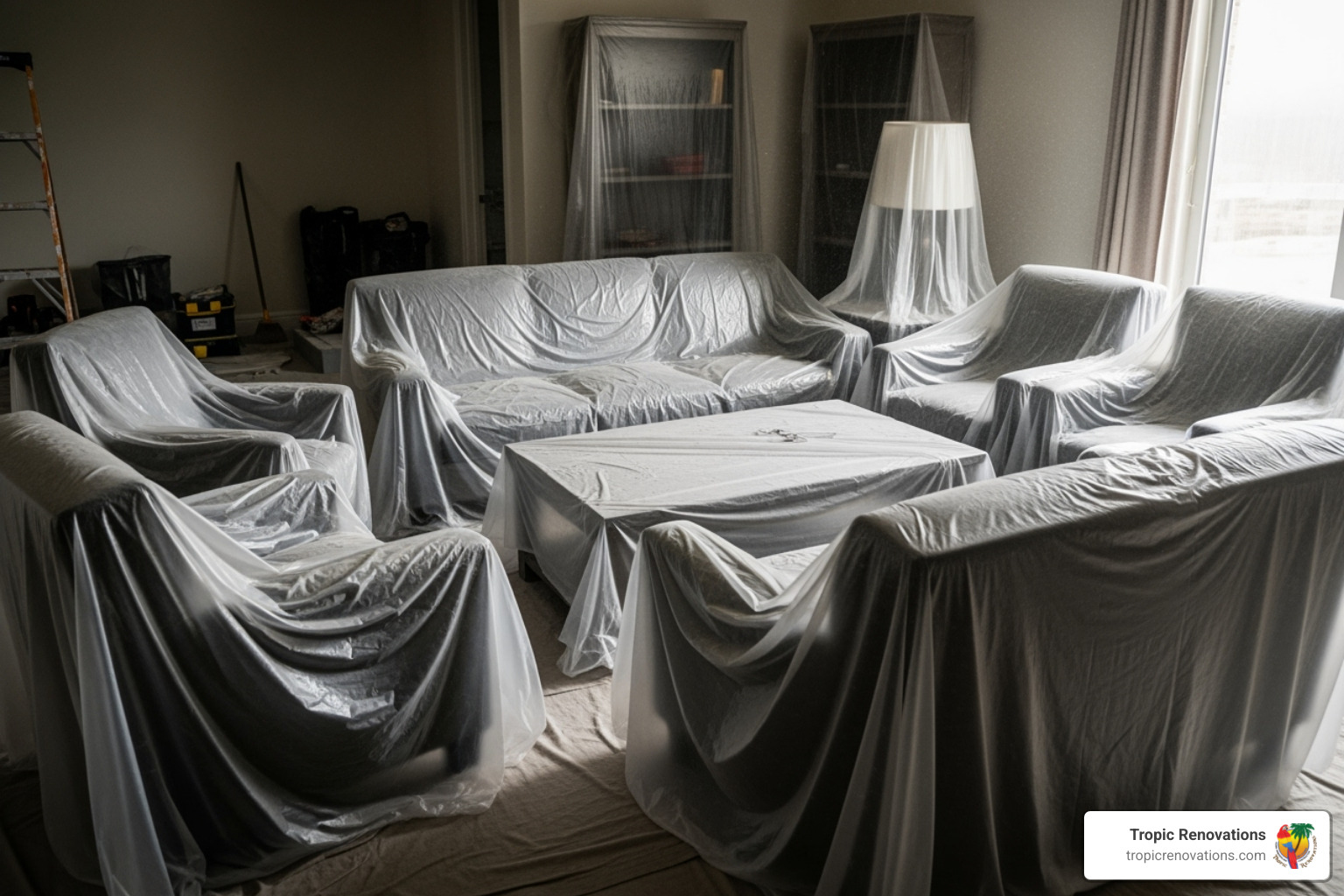
We take protecting your valuables seriously. Every piece of furniture gets covered with heavy-duty plastic sheeting, and we use specialized floor protectors to prevent scratches, stains, and embedded dust. Our goal is simple: when we’re done, the only thing that should look different is your beautiful new renovation – not a layer of grime on everything you own.
This careful approach prevents those costly post-construction cleanups that can add thousands to your renovation budget. More importantly, it preserves your home’s value and keeps your cherished belongings in pristine condition. The EPA Lead Renovation Rule and OSHA guidelines exist for good reasons, and we follow them religiously to ensure your family’s safety and your property’s protection.
The 3-Pronged Strategy for a Dust-Free Remodeling Project
When you’re dreaming of that perfect kitchen or bathroom renovation, the last thing you want to worry about is dust coating every surface in your home. That’s exactly why we’ve developed our proven 3-pronged strategy for achieving truly dust free remodeling.
Our approach isn’t complicated, but it is comprehensive. We focus on three key areas: Containment, Collection, and Cleaning. Think of it like building a fortress against dust – we stop it from spreading, capture it where it starts, and clean up whatever manages to slip through.
This systematic approach combines professional-grade methods with smart DIY techniques that any homeowner can understand. The result? You get to enjoy your renovation without turning the rest of your home into a dust bowl.
Prong 1: Containment – The Foundation of Dust Free Remodeling
Imagine trying to contain a cloud of flour in your kitchen – that’s essentially what we’re doing with construction dust, except the stakes are much higher. Containment is absolutely critical because once dust escapes the work area, it can travel throughout your entire home.
We start by creating what’s essentially a sealed construction zone. Using heavy-duty plastic sheeting (we’re talking 4-6mm thick – not the flimsy stuff), we build temporary walls from floor to ceiling. Every doorway gets the full treatment, either sealed completely with tape or fitted with specialized zippered door systems that let us move in and out without breaking the seal.
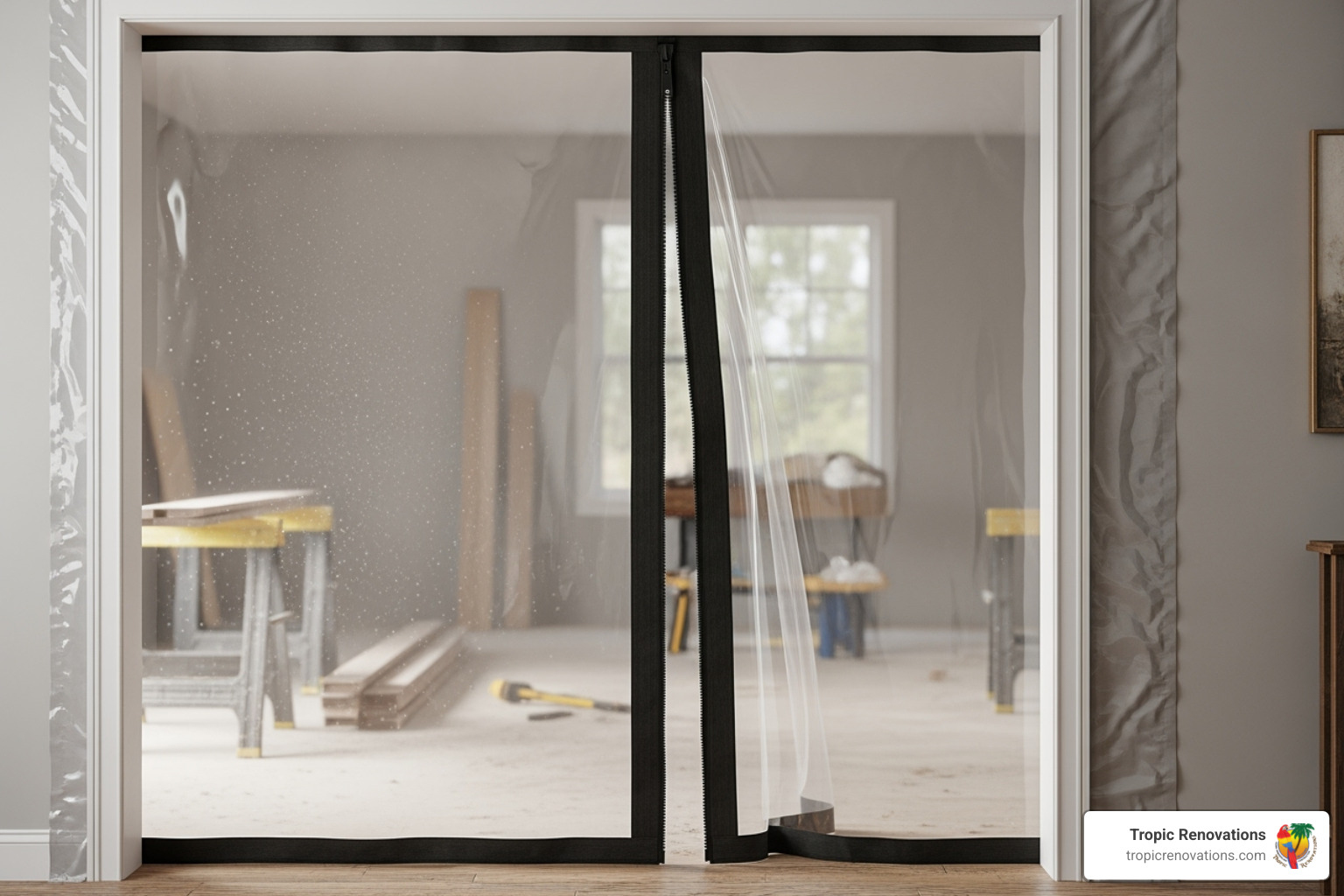
Here’s where it gets clever: we create negative air pressure in the work area. By placing powerful fans in windows to blow air out of the renovation space, we create a slight vacuum effect. This means any air that leaks through our barriers flows into the work zone, not out into your clean living spaces. It’s like having an invisible force field protecting the rest of your home.
Floor protection is another crucial piece of the puzzle. We lay down specialized films or protective boards to shield your existing flooring from dust, debris, and our work boots. And those sticky mats you might have seen at construction sites? We use those too, placing them at key entry points to capture dust before it can travel.
All those vents in your work area get sealed up tight, and we make sure your HVAC system isn’t accidentally spreading dust to other rooms. For more details on how we handle interior work with this level of care, check out our Drywall & Texturing process.
Prong 2: Collection – Advanced Tactics for Dust Free Remodeling
Once we’ve got the work area locked down, our next mission is to capture dust right where it’s born – at the business end of our tools. This is where the magic really happens, and frankly, where most DIY projects fall short.
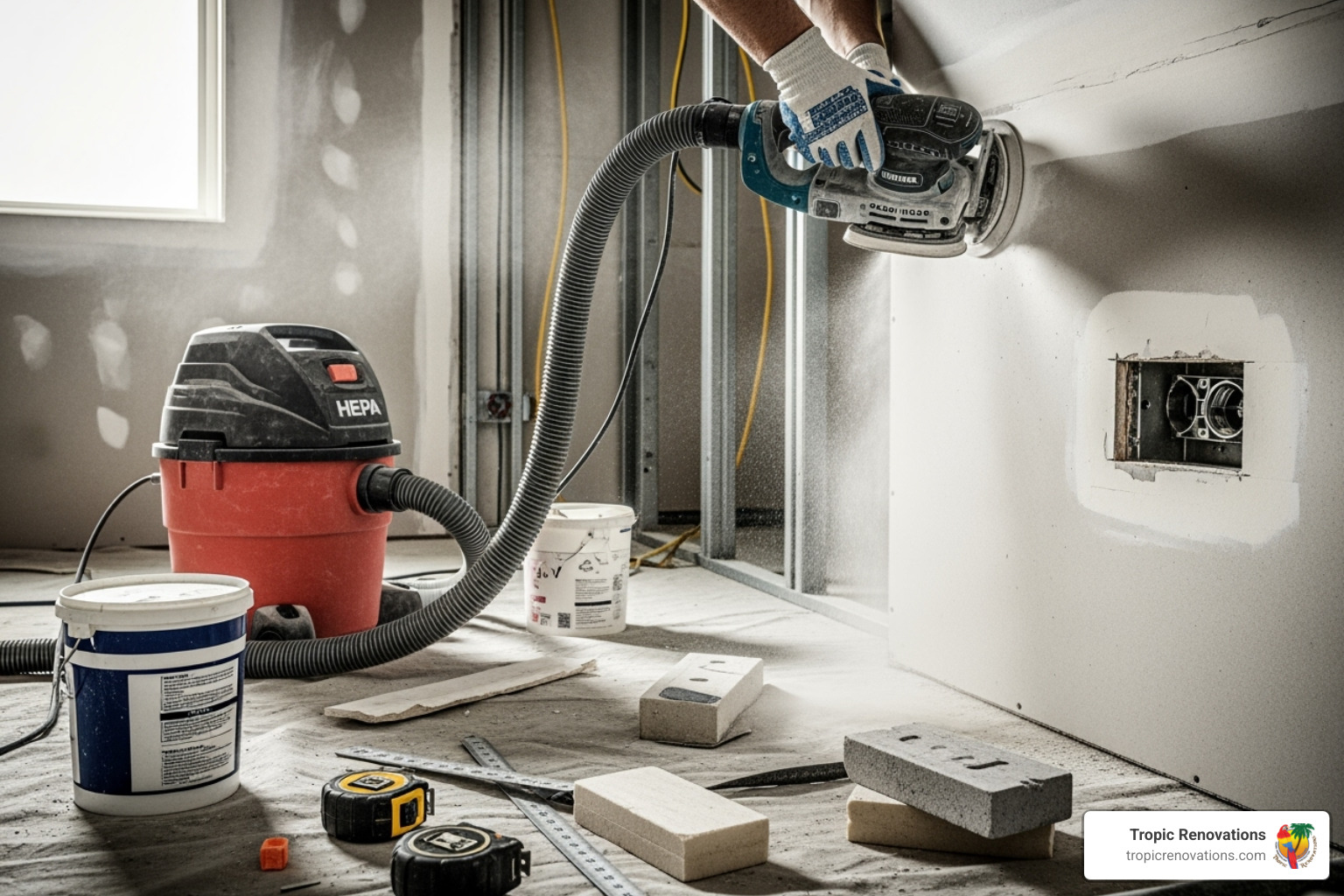
Our power tools aren’t your average hardware store variety. We use specialized equipment with built-in dust extractors that connect directly to powerful vacuum systems. When we’re sanding, cutting, or grinding, these systems can capture up to 90 percent of the dust as it’s created. It’s like having a dust-eating monster attached to every tool.
The secret weapon in our arsenal? HEPA filtration systems. These aren’t just fancy vacuum cleaners – HEPA filters capture 99.97% of particles as small as 0.3 microns. To put that in perspective, that’s smaller than most bacteria and includes all those nasty silica and lead particles we talked about earlier.
Air scrubbers work alongside our other equipment, continuously pulling dusty air from the work area and pushing out clean, filtered air. These machines are workhorses – they can filter the air in a typical kitchen every 10 minutes. Within an hour, they can bring particle counts down from hundreds of thousands to nearly normal levels.
Sometimes we go old-school with wet-cutting and wet-sanding techniques. Adding water to the equation might seem simple, but it’s incredibly effective at keeping dust from becoming airborne in the first place. When we’re working with concrete, tile, or even drywall, a little moisture can make a huge difference in dust control.
Want to see this approach in action? Our dustless popcorn ceiling removal service is a perfect example of how these collection techniques can tackle even the messiest jobs.
Prong 3: Cleaning – The Final Line of Defense
Even with world-class containment and collection, some dust will find a way to settle – it’s just the nature of construction work. That’s why our cleaning protocols are just as important as everything else we do.
Daily maintenance isn’t optional for us. At the end of every workday, our team does a thorough cleanup of the work area. We use only HEPA vacuums for this – regular vacuums actually make things worse by blowing fine particles back into the air. After vacuuming, we follow up with damp microfiber cloths to capture the tiniest particles that might have escaped.
The difference between HEPA vacuums and regular ones is night and day. Regular vacuums might pick up the big stuff, but they’re essentially dust redistributors when it comes to fine particles. HEPA vacuums actually capture and contain those microscopic troublemakers.
When your project wraps up, we don’t just pack up our tools and call it done. Our final deep clean is comprehensive – we clean every newly installed surface, wall, and fixture. We also recommend having your HVAC system professionally cleaned and getting those filters replaced to catch any stray dust that might have snuck through our defenses.
Here’s something that might surprise you: even with all our precautions, some dust particles can continue settling for five to six weeks after we finish. That’s just physics – those microscopic particles are incredibly light and can float around for a long time. But because we’ve controlled the source and done thorough cleaning throughout the project, this residual dust is minimal compared to what you’d see with traditional renovation methods.
The bottom line? Our three-pronged approach means you can actually live in your home during renovation without feeling like you’re camping in a construction zone.
Communicating Your Dust Control Expectations with a Contractor
The difference between a renovation nightmare and a smooth project often comes down to one thing: setting clear expectations from day one. We’ve seen too many homeowners get caught off guard because they assumed their contractor would automatically prioritize dust control. Don’t let that be you.
When you’re interviewing potential contractors, bring up dust free remodeling? early in the conversation. This isn’t just about convenience – it’s about protecting your family’s health and your home’s value. A contractor who takes dust control seriously will light up when you ask about it. One who doesn’t? Well, that tells you everything you need to know.
Start with a pre-project walkthrough where you can discuss your specific concerns. Maybe you have a family member with asthma, or expensive electronics that need extra protection. Perhaps you’re worried about dust reaching your baby’s nursery upstairs. Share these concerns openly – a good contractor will work with you to address them.
The contract review is where things get real. Your agreement should include a detailed dust control plan that spells out exactly how they’ll handle containment, collection, and cleaning. This isn’t just legal protection – it’s your roadmap to a cleaner renovation experience.
Don’t be shy about asking the tough questions. What specific tools do they use for dust mitigation? Do their sanders and grinders have built-in dust collection systems? How do they set up dust barriers? Look for contractors who mention heavy-duty plastic sheeting, sealed doorways, and zippered entry systems.
Air quality management is crucial too. Ask about air scrubbers and HEPA filtration systems. How often do they change filters? Will they establish negative air pressure in the work area? These technical details separate the pros from the amateurs.
Debris removal is another critical point. How will they get construction waste out of your home without spreading dust everywhere? The best contractors have specific protocols for this, often involving direct removal through windows or sealed pathways.
Don’t forget about your HVAC system protection. Will they seal vents and returns? How will they prevent dust from circulating through your entire home? And what about your existing floors and furnishings – what’s their protection plan?
Finally, ask about their daily cleaning routine. How often will they vacuum the work area? What type of vacuums do they use? Regular shop vacs can actually make dust problems worse by blowing fine particles back into the air.
At Tropic Renovations, we welcome these conversations because dust control is central to everything we do. With over 350 years of combined technician experience and our commitment to never subcontracting core trades, we’ve perfected our dust control protocols through countless projects. We’re always happy to walk you through our three-pronged approach and answer every question you have.
A contractor who gets defensive about dust control questions probably isn’t the right fit for your project. The right contractor will appreciate your attention to detail and use it as an opportunity to showcase their expertise.
Frequently Asked Questions about Dust Control
We get a lot of questions from homeowners who are excited about their renovation but worried about the mess. Let’s be honest – dust concerns keep many people up at night before a big project starts. Here are the answers to the questions we hear most often, straight from our team who’s been doing this for decades.
How does dust-free demolition differ from traditional demolition?
Picture this: traditional demolition looks like something out of a disaster movie. Workers swing sledgehammers with abandon, clouds of dust billow everywhere, and you’re left wondering if your home will ever feel clean again. It’s messy, chaotic, and frankly, pretty unhealthy for everyone involved.
Dust-free demolition is the complete opposite. We approach it like surgeons rather than demolition crews. Instead of creating massive dust clouds, we use specialized tools that capture particles right at the source. Think of advanced tile removal systems that literally vacuum up debris as we work, capturing over 99.9% of dust particles before they ever become airborne.
The difference is night and day. With traditional methods, you’re dealing with minimal airborne debris instead of choking dust clouds. Your cleanup is faster, your air is cleaner, and the whole process is infinitely more civilized. While we can’t promise absolutely zero dust (we’re renovating, not performing magic), the amount is so minimal you’ll barely notice it.
The healthier process means you can often stay in your home during renovation instead of fleeing to a hotel. That’s a game-changer for families with kids, elderly relatives, or anyone with respiratory sensitivities.
How can I protect my furniture and floors during a remodel?
This is where a little preparation goes a long way. Think of it as getting ready for a friendly invasion – you want to protect what matters most.
Start by removing all small items from the renovation area. Those family photos, decorative bowls, and knick-knacks that make your house feel like home? Box them up and store them safely away from the action. It’s easier to pack them now than to dust them daily for weeks.
For large furniture that can’t be moved – your beautiful dining set or that couch you finally paid off – we cover everything with heavy-duty plastic sheeting. We’re talking thick, durable stuff, not the flimsy grocery store plastic. We drape it completely and seal the edges with tape to create a dust-tight cocoon around your belongings.
Your floors get the VIP treatment too. We lay down durable floor protectors – specialized films for finished floors and sturdy protective boards for high-traffic areas. We also create designated walkways with protective coverings, so there’s a clear, clean path from the work zone to the outside. Think of it as a red carpet, but for construction workers.
The key is thinking ahead. A few hours of preparation saves you weeks of cleaning later.
How long does it take for construction dust to fully settle after a remodel?
Here’s the answer that surprises most people: even with dust free remodeling? techniques, some fine particles can keep settling for five to six weeks after we finish your project. We know – it sounds like forever when you’re eager to enjoy your beautiful new space.
Here’s why it takes so long. The tiniest particles from drywall sanding and other activities are incredibly light – almost weightless. They float around like invisible snow, and every time someone walks through the house or you run your heating or cooling system, these fine particles get stirred up again.
Your HVAC circulation system, while great for comfort, can actually work against you here. It picks up these microscopic particles and distributes them throughout your entire home, even to rooms that weren’t part of the renovation. That’s why protecting and cleaning your air ducts is so important.
The good news? Most of the dust settles within the first few days. What lingers after that is minimal, but it’s why our final deep clean is so thorough. We don’t just wipe surfaces – we systematically remove every trace we can find.
Our advice? Air out the house on calm, dry days after completion, and replace your HVAC filters right away. Then be patient with those last few particles. Your beautiful new space is worth the wait.
Conclusion: Enjoy a Cleaner, Healthier Renovation
Your dream renovation doesn’t have to come with a side of dust bunnies and respiratory irritation. We’ve walked through the complete roadmap to achieving truly dust free remodeling? – and yes, it really is possible with the right approach.
Remember our three C’s: Containment, Collection, and Cleaning. These aren’t just fancy buzzwords – they’re your shield against the dust nightmare that haunts too many renovation projects. When we seal off your work area with proper barriers and negative air pressure, capture dust right at the source with HEPA-equipped tools, and maintain rigorous daily cleaning protocols, we’re not just being thorough. We’re protecting what matters most: your family’s health and your home’s value.
The long-term benefits of this approach extend far beyond the renovation itself. You’ll breathe easier knowing your family isn’t exposed to harmful silica dust or lead particles. Your HVAC system stays clean and efficient. Your electronics and furnishings remain pristine. And here’s the best part – you actually get to enjoy your beautiful new space immediately, instead of spending weeks cleaning up construction dust.
Think about it: what good is a gorgeous new kitchen if you’re still finding drywall dust in your coffee cups months later? With proper dust control, that’s simply not an issue.
At Tropic Renovations, we’ve made dust-free practices a cornerstone of our approach because we know your home is more than just a construction site – it’s where you live, breathe, and make memories. Our state-licensed team serves Sarasota & Charlotte County, FL, and surrounding areas including Casey Key, Englewood, Manasota Key, Nokomis, North Port, Osprey, Palmer Ranch, Siesta Key, Southwest Florida, and Venice.
With over 350 years of combined technician experience and our commitment to never subcontracting core trades, we bring both expertise and accountability to every project. We complete renovations in 6 months or less, specializing in kitchens and baths that transform your space without changing your air quality.
Your peace of mind during renovation is just as important as the final result. When you choose dust-free remodeling, you’re choosing to protect your family’s health while creating the home you’ve always wanted.
Ready to experience the difference? Start your dust-free home renovation with us today and find what it’s like to renovate without compromise.