
How to plan renovation? 5 Key Phases: Ultimate Success
Why Planning Your Renovation is the Key to Success
How to plan renovation starts with understanding that a home renovation can feel like a rollercoaster of surprises. It’s easy to feel overwhelmed, especially on your first major project, when you “don’t know what you don’t know.”
Quick Planning Steps:
- Define your vision – Create a needs vs. wants list
- Set a realistic budget – Include 10-20% contingency fund
- Research and hire professionals – Vet contractors thoroughly
- Obtain necessary permits – For structural, electrical, and plumbing work
- Plan the timeline – From demolition to final finishes
- Prepare for disruption – Set up temporary living spaces
The good news? Homeowners who thoroughly plan their renovations are 50% less likely to experience significant budget overruns. The time you invest upfront in careful planning pays off dramatically during construction.
Whether you’re updating a single room or tackling a whole-home remodel, a clear roadmap eliminates costly surprises and reduces stress. This guide will walk you through each phase of the renovation planning process.
I’m Jeff Lexvold, and over nearly two decades in construction, I’ve helped renovate over 1,000 homes before starting Tropic Renovations. My experience has taught me that knowing how to plan renovation properly separates successful projects from costly disasters. Let me share the proven strategies that will help you steer your renovation journey with confidence.
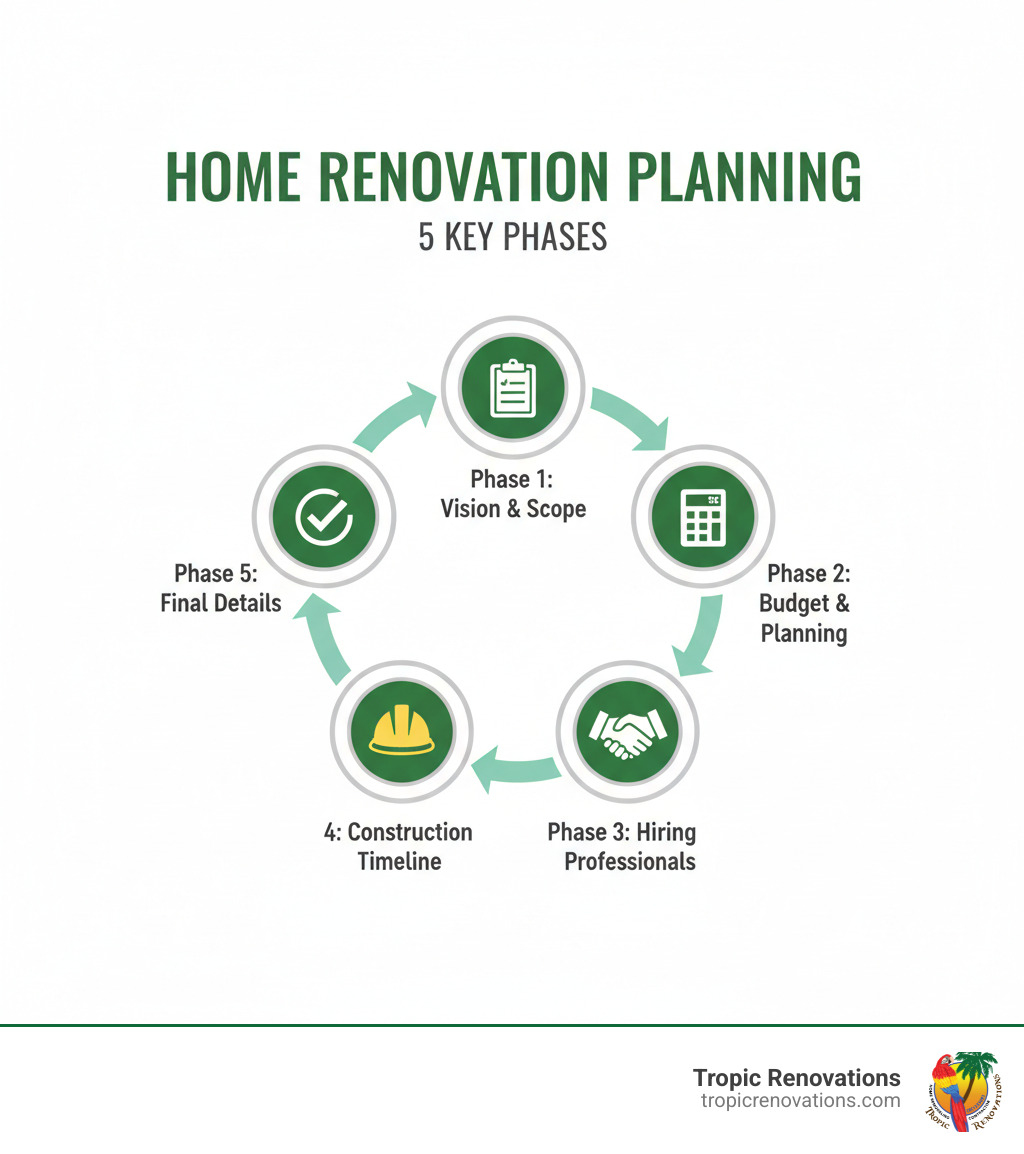
Easy How to plan renovation? word list:
Phase 1: Defining Your Vision & Scope
When you look around your home, you might feel that something needs to change—a cramped kitchen or a tiny bathroom. How to plan renovation starts with turning those feelings into a clear vision. Every successful renovation begins with understanding what you want to achieve. It’s about improving how you live in your space, not just picking trendy fixtures.
The key is separating your needs from your wants. Needs are functional issues, like a narrow hallway or a single bathroom creating morning chaos. Wants are aesthetic dreams, like marble countertops or a spa-like master bath. Understanding the difference helps you set clear goals and make smart budget decisions.
Consider your future needs, too. Are you planning to start a family or will aging parents move in? These life changes can affect what renovations make sense for your long-term happiness.
Return on Investment (ROI) is another crucial factor. While personal enjoyment is key, it’s smart to understand which improvements add lasting value versus those that are purely personal preferences.
Start gathering inspiration by creating a mood board with fabric swatches, paint chips, and magazine cutouts. Visit showrooms and browse online galleries. The goal is to identify patterns in what catches your eye, not just copy someone else’s style.

Creating Your Renovation Wish List
Now, create your official wish list. Prioritize changes from most urgent to “nice to have.” Walk through your home and assess what frustrates you and what you love.
Functional improvements might include adding storage or updating outdated electrical systems. Aesthetic upgrades could be fresh paint or new lighting. Be specific about how each issue affects your daily life. Instead of writing “kitchen too small,” try “can’t have more than one person cooking at a time.” Worksheet “C” can help you organize these thoughts.
Defining your personal style is equally important. Don’t just follow trends from Pinterest or Instagram. Focus on what consistently appeals to you to create a space that feels like home. Get input from everyone in your household; fresh eyes can spot issues you’ve overlooked.
How to Plan Renovation for Long-Term Value
Smart renovation planning assesses future needs for your family. Planning with flexibility in mind can save you from another major renovation down the road.
Improving energy efficiency during renovation is a wise move. Since you’re already opening up walls, it’s the ideal time to add insulation, upgrade windows, or install more efficient HVAC equipment. These improvements pay off in comfort and lower utility bills.
High-ROI projects like kitchens and baths consistently offer strong returns, with kitchen renovations potentially yielding 60-80% ROI. These spaces are important for resale value and your daily life. For a deeper dive, check out Are Renovations Worth It?.
Don’t overlook smart home upgrades. Integrated systems for lighting, security, and climate control can transform your home. Plan the infrastructure during the renovation rather than trying to add it later. The best projects balance financial wisdom with personal enjoyment.
Phase 2: Budgeting and Professional Planning
With your vision clear, it’s time for budgeting and assembling your team. This phase turns dreams into a solid, actionable plan.
Here’s the reality: homeowners typically underestimate renovation costs by 20-30%. This is why we always build in a contingency fund of 10-20% of your total project budget. This buffer is your safety net for when a “simple” wall removal reveals complex electrical work that needs relocating.
The planning and design phase accounts for 10-20% of your total renovation budget, but it’s money well spent as insurance against costly mistakes and change orders. For financing, smaller projects might work with cash, while larger ones often benefit from unsecured home improvement loans ($50,000-$100,000) or home equity lines of credit (HELOCs).

How to Determine a Realistic Renovation Budget
A good budget breaks down all expenses: labor, materials, permits, design fees, and the contingency fund. Costs vary, but renovations often run $15 to $60 per square foot. A 1,250-1,600 sq ft home might average $52,040, but can reach $189,000 or more with luxury finishes.
Getting at least three quotes is essential. This helps you understand fair market pricing and compare bids accurately. Wildly different bids are a red flag that a contractor may have misunderstood the scope or is cutting corners.
Handy homeowners can save $5,000 to $10,000 on DIY tasks like demolition or painting. However, be honest about your abilities, as fixing mistakes can be more costly than hiring a pro. Also, remember hidden costs like fixtures, hardware, and appliances, which add up quickly.
For a comprehensive breakdown, see our guide: How to Plan Your Home Renovation. For more tips, you can GET FREE ACCESS TO THE GUIDE ››.
Choosing Your Professional Team
Choosing a contractor is personal; you’re inviting them into your home for months. Vetting contractors thoroughly means checking licenses, insurance, past work, and client testimonials. Word-of-mouth recommendations are valuable, but also read online reviews to get a broader picture.
At Tropic Renovations, a state-licensed contractor in Sarasota & Charlotte County, FL, our team has 350+ years of combined technician experience. A key differentiator is that we never subcontract our core trades. This ensures consistency, quality, and security.
A good contractor-client relationship is a partnership. Look for contractors who interview you as thoroughly as you interview them, asking detailed questions about your lifestyle and priorities. Clear communication is as vital as craftsmanship. Your contractor should be responsive and explain the process clearly. Trust your gut if you feel rushed or dismissed.
For more guidance, see our resources: How to Choose a Home Remodeling Contractor and What is a Design Build Contractor?.
| Feature | General Contractor (GC) | Design-Build Firm |
|---|---|---|
| Project Flow | Client hires designer/architect, then GC. | Integrated design and construction team. |
| Communication | Client manages communication between designer and GC. | Single point of contact for design and construction. |
| Cost Control | Design completed before GC bid, potential for change orders. | Cost considerations integrated from early design. |
| Timeline | Can be longer due to separate design and build phases. | Often more streamlined due to integrated process. |
| Accountability | Separate accountability for design and construction. | Single accountability for entire project. |
| Suitability | Good for complex, highly custom designs with separate design preference. | Ideal for homeowners seeking efficiency and streamlined process. |
The Importance of Permits and Building Codes
Permits and building codes are a critical, if unglamorous, part of planning. Permits ensure your project is safe, legal, and insurable. Ignoring them can lead to fines, delays, or being forced to tear out completed work, which can become a nightmare when selling your home.
Permits are generally required for any structural changes, electrical work, or plumbing modifications. The process varies, but building consent often takes a minimum of 20 days. For local regulations in our service area, see the Charlotte County site: Residential Remodel – Permits – Charlotte County.
We handle all necessary permits for our clients. An experienced contractor’s knowledge of local codes is essential for a smooth, legal, and safe project. Permits are your protection, ensuring work is done safely and will pass future inspections.
How to Plan Renovation: The Construction Phase
The construction phase turns your plans into reality. Understanding the process helps manage expectations and reduces stress.
A whole-home renovation can take 6 months or more. A bathroom remodel is typically 2-4 weeks, and a kitchen 6-8 weeks. Timelines vary with project complexity and any surprises we uncover. A smooth construction phase follows a logical sequence for efficiency and safety.

The Step-by-Step Renovation Timeline
The construction sequence builds upon itself, step-by-step:
- Demolition and site prep kicks things off. We remove old materials and set up protective barriers to contain dust.
- Framing and structural changes come next, creating the new layout’s skeleton.
- The mechanical rough-in for HVAC, plumbing, and electrical happens while walls are open, which is crucial for access and cost-effectiveness.
- Insulation and drywall installation turns the site back into rooms. We install insulation, then hang, tape, and finish the drywall to create a smooth canvas.
- Flooring and painting are carefully sequenced based on project materials to ensure a clean finish.
- Cabinet and fixture installation restores functionality. Kitchens and bathrooms become usable again as cabinets and large appliances are installed.
- Final touches like backsplashes, light fixtures, and hardware complete the look and make the space feel like home.
Managing the ‘Behind-the-Scenes’ Essentials
The ‘unseen’ systems—plumbing, electrical, and HVAC—are critical for your comfort and safety. Getting them right prevents future problems.
HVAC system upgrades are ideal during a renovation. It’s a chance to install more efficient equipment and ensure the new layout has proper airflow.
Electrical safety and panel upgrades are essential. Licensed electricians must handle this work to prevent fire hazards and support modern power demands, which may require a panel upgrade.
Plumbing considerations are key in kitchens and baths. We plan for optimal water pressure, drainage, and ventilation to prevent moisture issues that can affect health, as noted by the EPA: Protect Indoor Air Quality in Your Home.
At Tropic Renovations, we never subcontract our core trades. Our own licensed technicians handle these critical systems, and all work is inspected and approved before walls are closed. No shortcuts.
Bringing Your Vision to Life with Finishes and Details
This final phase is about finishes. Selecting materials like countertops and tile requires balancing your vision with your budget and timeline.
Material selection is about more than looks. We help you choose durable, lifestyle-appropriate materials, like moisture-resistant options for bathrooms and easy-to-clean surfaces for kitchens.
Product sourcing and lead times can cause delays. Custom cabinetry can take 8-12 weeks (sometimes up to 16), and other special-order items also have long lead times. We plan for this and order key items as early as possible.
Lighting, hardware, and fixtures are the ‘jewelry’ of your home. A good lighting plan uses a mix of ambient, task, and accent lighting. These details add personality and complete your design.
Navigating Challenges and Living Through the Dust
Even with careful planning, renovations have curveballs. A key part of how to plan renovation is preparing for these inevitable bumps in the road. Living through a renovation can be overwhelming, but preparation and the right mindset can turn a stressful experience into a manageable one.

Mitigating Common Renovation Challenges
Supply chain delays are common. A specific tile might be backordered for weeks. We leverage supplier relationships to find alternatives or get priority, and we communicate any delays and timeline adjustments immediately.
Hidden surprises like outdated plumbing, mold, or structural issues can be nerve-wracking. This is exactly why a 10-20% contingency fund is your safety net. Our experienced team is skilled at spotting potential issues early to prevent them from escalating.
Communication is crucial. We practice radical transparency. If we find something unexpected, we inform you immediately with a solution and cost implications.
Change orders can affect your budget and timeline. We finalize details upfront, but if you want to make a change, we discuss the impact on cost and schedule and get your approval before proceeding. For more tips, see this A 10-Step Checklist For Renovation By Mortgage House.
How to Prepare Your Home and Family for Disruption
Living through a renovation requires patience. The first big decision is whether to stay in your home or relocate temporarily. A rental may be best for whole-home projects, but staying is manageable for most kitchen and bath remodels with proper preparation.
Set up temporary living zones. A temporary kitchen with a microwave and mini-fridge can be set up in a dining room. Plan around your daily routines.
Identify a “construction-free zone” where you can escape the dust and chaos. This sanctuary is vital for maintaining sanity, especially if you work from home.
We take protecting your belongings seriously, sealing off work areas. Our specialty is Dust Free Remodeling, which significantly reduces mess and disruption.
Safety is paramount, especially with children and pets. We establish safety zones and provide daily schedules so you can plan around noisy work. Daily HEPA vacuuming and air purifiers also help maintain air quality. There will be tough days, but families who prepare well and keep a sense of humor often look back on the renovation as a positive experience.
Frequently Asked Questions about Planning a Renovation
After helping with over 1,000 home projects, I’ve heard every question about how to plan renovation. Here are answers to the most common ones.
What is the best order to renovate a house?
The golden rule is to always work from structural to cosmetic. This prevents damaging finished work.
Start with exterior and structural issues like the foundation, roof, and windows to protect the interior work. Next is the interior systems rough-in (HVAC, electrical, plumbing) while walls are open. After inspection, we install insulation and drywall. Then comes flooring and painting, followed by cabinetry, fixtures, and the final touches that complete the space. This sequence saves money by avoiding rework and protecting your new finishes.
Can I do a renovation myself?
DIY is great for cosmetic tasks like painting, installing new hardware, or some demolition. It can save you thousands and provide a sense of accomplishment.
However, safety and building codes require licensed professionals for any electrical, plumbing, gas, or structural work. This is for your family’s safety, your home’s insurance, and to ensure quality. DIY mistakes on these critical systems can lead to expensive repairs and code violations. Know your limits and be honest about your skills and available time.
If you’re considering DIY to save money, get a professional consultation first. The total cost of tools, materials, and permits might make professional installation more competitive than you think. For more on this, see our guide: Can You Remodel Your Home Without a General Contractor?
How long does a typical home renovation take?
Renovation timelines depend heavily on scope and complexity. Here are typical estimates:
- A single bathroom remodel usually takes 2-4 weeks.
- Kitchen remodels are more complex, typically 6-8 weeks, but can extend to 12 weeks with custom elements.
- Whole-home renovations can take 6 months to a year, especially with additions or major structural changes.
At Tropic Renovations, we pride ourselves on completing most projects in 6 months or less. Our in-house trades eliminate subcontracting delays and quality control issues that can stretch timelines. Hidden surprises can add time, which is why buffer time and a contingency fund are so important.
Your Dream Home Awaits
Understanding how to plan renovation is the foundation for turning your vision into reality. This guide has walked you through every crucial step, from defining your dreams to navigating the construction phase.
The benefits are clear: Planned renovations are 50% less likely to have budget overruns. Proper planning gives you peace of mind and confidence in your project, eliminating sleepless nights.
From your mood board to final finishes, each step builds certainty. You know your vision, understand your budget, and have strategies to handle surprises along the way.
The value of an expert partner makes all the difference. At Tropic Renovations, our state-licensed team brings over 350 years of combined technician experience to your project. We specialize in comprehensive, dust-free renovations to minimize disruption during construction.
What sets us apart is our commitment to never subcontracting our core trades. Our own licensed professionals handle all plumbing, electrical, and HVAC work. This streamlined approach allows us to complete most projects in 6 months or less—getting you back to enjoying your dream home faster.
With this knowledge and the right team, your renovation can be rewarding, not stressful. We’re here to make your dream home a reality.
Start planning your Sarasota or Charlotte County renovation today!